
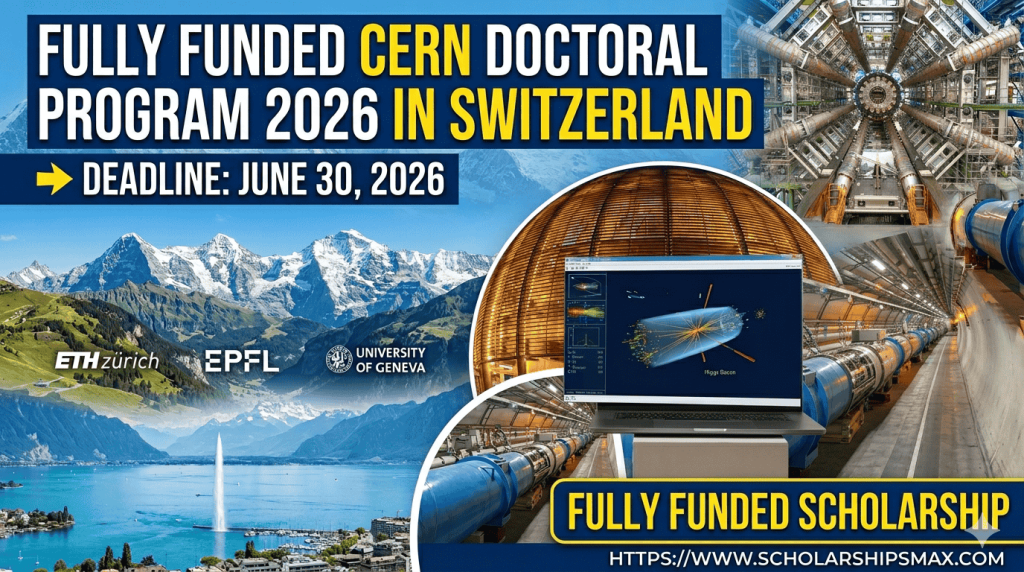
The Fully Funded CERN Doctoral Program 2026 is now taking applications. It’s fully funded, it’s in Geneva, and honestly? It’s probably the coolest thing you could put on a CV. If you’re tired of the same old lab equipment at your home uni, imagine swapping it for the Large Hadron Collider.
| Quick Reference | Info |
| Where | Geneva, Switzerland |
| Money | 3,907 CHF / Month |
| Length | 1 to 3 Years |
| Deadline | June 30, 2026 |
| Status | Fully Funded |
About Fully Funded CERN Doctoral Program 2026 in Switzerland
CERN isn’t just a giant building full of magnets. It’s a bit like a small city of nerds (and I say that with total respect). You’ve got people from every corner of the globe walking around the Meyrin site, arguing about particle trajectories over coffee.
When you join as a doctoral student, you aren’t just an intern making photocopies. You are a research associate. You stay enrolled at your home university, but you live and work in Geneva for anywhere from a year to three years. You’re solving actual problems—whether that’s debugging a data bottleneck that’s holding up an experiment or literally helping build the next generation of superconducting magnets. It’s high-stakes, high-reward, and incredibly social. For More Fully Funded Scholarships Program click Here
Benefits of Fully Funded CERN Doctoral Program 2026 in Switzerland
Switzerland is notoriously expensive. A cup of coffee in Geneva can cost more than a meal in other parts of the world. Because of that, CERN doesn’t just give you a “stipend”—they give you a living allowance that actually lets you live.
1. The Monthly Allowance
You get 3,907 Swiss Francs (CHF) every month. Since this is a “subsistence allowance” and not a standard salary, it’s usually tax-free. This is plenty to cover a nice apartment, your groceries, and still have enough left over to go skiing on the weekends.
2. Moving and Health
They don’t expect you to pay your way to Switzerland. CERN covers your travel costs from your home country to Geneva. Once you arrive, you’re also covered by their comprehensive health insurance. If you have a spouse or children, there are extra family supplements available to make sure everyone is taken care of.
3. Time Off
You aren’t a robot. You get 30 days of paid leave a year. On top of that, the whole place shuts down for two weeks in December, which is basically a mandatory holiday. It’s a great chance to go home or explore the rest of Europe.
Check Eligibility for Fully Funded CERN Doctoral Program 2026 in Switzerland
CERN is a member-state organization, which means there are some specific rules about who can get in.
- Your Passport Matters: You need to be a national of a CERN Member or Associate Member State.
- Student Status: You should either be already working on your PhD or be just about to start.
- The Subject: Your research needs to be “CERN-relevant.” We’re talking Applied Physics, IT, Mathematics, Electrical, Mechanical, or even Civil Engineering. If your work helps the machines run or the data move, you’re in.
- Languages: You need to be decent in English or French. You don’t need to be Shakespeare, but you need to be able to explain your work to your teammates.
Getting Fully Funded CERN Doctoral Program 2026 in Switzerland Application process
Applying is done online, and while you can use LinkedIn to pull in your history, I’d suggest doing it manually to make sure everything is perfect.
Step 1: The CV
Keep it clean. Don’t just list your classes; list what you’ve built or solved. If you coded a specific tool or managed a project, put that front and center.
Step 2: The Paperwork
You’ll need your most recent academic transcripts. These must be in English or French. If yours are in another language, you’ll need a certified translation. Also, get a reference letter from your professor. It says “optional” on the site, but let’s be honest: in a competitive program like this, “optional” means “do it if you want the job.”
Step 3: The Motivation Section
This is where people mess up. Don’t tell them CERN is a “great opportunity.” They know that. Tell them why your specific research is a perfect match for their current projects. Are you working on a specific type of sensor? Mention that. Are you an expert in a niche programming language they use? Mention that.
Life in Geneva: Beyond the Lab
Living in Geneva is a bit of a dream. You’re right on the border of France—in fact, part of CERN is actually in France. You can live in a French village and commute into Switzerland every morning.
On the weekends, the Alps are right there. If you like hiking, skiing, or just looking at mountains while eating fondue, you’re going to love it. The “CERNie” community is huge, so there are always clubs, sports teams, and parties happening. It’s not just about the physics; it’s about the experience of living in the heart of Europe.
Important Dates and Deadlines
Last date for Fully Funded CERN Doctoral Program 2026 in Switzerland June 30, 2026.
Mark it in your calendar. Set a reminder. Tell your mom. Whatever you do, don’t wait until June 29th. The servers get slow when everyone tries to upload their PDFs at once, and you don’t want a technical glitch to ruin your chances of a lifetime.
Final Thoughts: Just Go For It
I talk to a lot of students who think they “aren’t smart enough” for CERN. That’s nonsense. CERN is made up of regular people who are just really curious and aren’t afraid to try. If you meet the criteria and you’re passionate about your research, you have as good a shot as anyone else.
Update your CV tonight. Reach out to your professor tomorrow. This could be the start of the biggest three years of your life.